

Workplace Harassment in Argentina
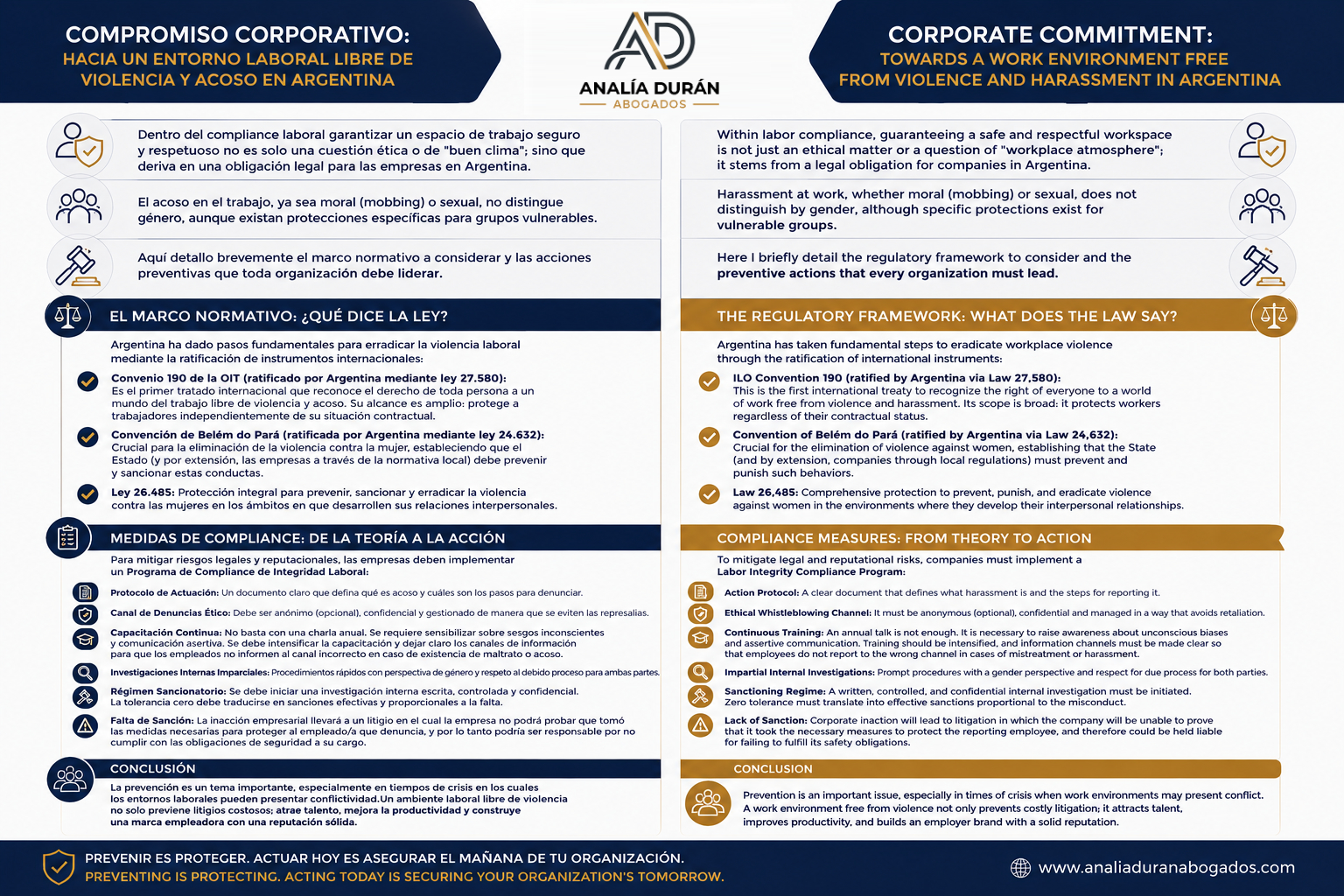
Within the scope of labor compliance, guaranteeing a safe and respectful workspace is not merely a matter of ethics or “workplace culture”; it is a formal legal obligation for companies in Argentina. Harassment—whether psychological (mobbing) or sexual—does not discriminate by gender, though specific protections exist for vulnerable groups.
Below is a brief outline of the regulatory framework to consider and the preventive actions that every organization must lead.
The Regulatory Framework: What Does the Law Say?
Argentina has taken fundamental steps toward eradicating workplace violence by ratifying international instruments:
- ILO Convention 190 (Ratified by Law 27.580): This is the first international treaty to recognize the right of everyone to a world of work free from violence and harassment. Its scope is broad: it protects workers regardless of their contractual status.
- Belém do Pará Convention (Ratified by Law 24.632): Crucial for eliminating violence against women, establishing that the State (and by extension, companies through local regulations) must prevent and punish these behaviors.
- Law 26.485: Comprehensive protection to prevent, punish, and eradicate violence against women in the environments where they develop their interpersonal relationships.
Compliance Measures: From Theory to Action
To mitigate legal and reputational risks, companies must implement a Labor Integrity Compliance Program:
- Action Protocol: A clear document defining what constitutes harassment and the specific steps for reporting it.
- Ethical Reporting Channel (Whistleblowing): It must be confidential, allow for anonymity (optional), and be managed in a way that prevents retaliation.
- Continuous Training: An annual talk is not enough. It is necessary to raise awareness regarding unconscious bias and assertive communication. Training must be intensified, and information channels must be clearly defined so that employees do not report to the wrong channel in cases of mistreatment or harassment.
- Impartial Internal Investigations: Prompt procedures conducted with a gender perspective and respect for due process for both parties.
- Disciplinary Regime: A written, controlled, and confidential internal investigation must be initiated. Zero tolerance must translate into effective sanctions proportional to the offense.
- Consequences of Inaction: Business inaction will lead to litigation in which the company will be unable to prove it took the necessary measures to protect the reporting employee. Consequently, the company could be held liable for failing to meet its safety and security obligations.
Conclusion
Prevention is a critical issue, especially in times of crisis where work environments may become prone to conflict. A work environment free of violence does not just prevent costly litigation; it attracts talent, improves productivity, and builds an employer brand with a solid reputation.