

Digital evidence and preservation: is your company’s data secure?
A lawyer specializing in corporate labor law and data compliance does not merely minimize litigation risk—they design the entire preventive architecture. Training serves as the bridge that allows this framework to function within the company, mitigating risks during labor inspections, data breaches, or employment litigation.
Information security, work equipment management, know-how, and digital evidence preservation are critical to prevent legal risks.
We face two key principles that may seem to conflict, but with proper safeguards, can harmoniously coexist. On one hand, in Argentina, the employer holds the right to monitor operations while maintaining the duty of confidentiality. On the other hand, the employee is entitled to constitutional rights to privacy and personal data protection.
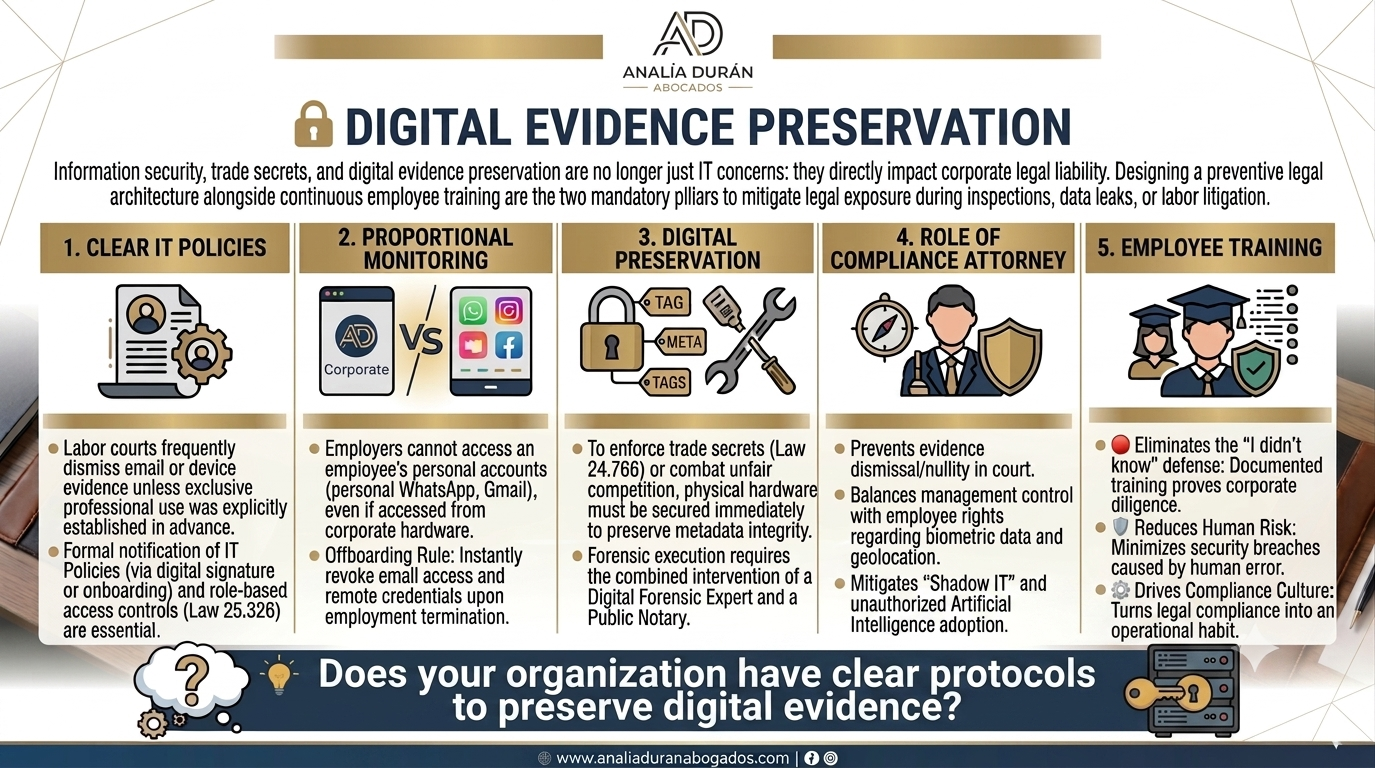
1. Prevention Hub: Clarity in Communication
Traditionally, labor courts have deemed evidence extracted from emails or electronic devices inadmissible if the employer failed to establish beforehand that those channels were strictly for professional use.
- Acceptable Use Policy (IT Policy): Must be formally and demonstrably acknowledged (via digital signature, written consent during onboarding, or annual renewals). Employers must clearly define which tools and assets are company property. Server access protocols must also be explicitly included.
- Personal Data Protection Policies: Define access levels (role-based access) to sensitive customer and employee data to comply with the security principle established under Argentine Personal Data Protection Act No. 25,326.
2. Monitoring Without Infringing on Privacy
Monitoring must be proportionate and restricted strictly to corporate assets.
- Corporate vs. Personal Accounts: Accessing an employee’s personal accounts (such as personal WhatsApp or personal Gmail) is strictly prohibited, even if accessed from a company-owned computer. Monitoring must focus exclusively on company-provided tools.
- Termination Protocols: Always revoke email access immediately upon an employee’s departure—regardless of the reason for termination—and terminate all remote network access.
3. Active Preservation and Safeguarding of Digital Evidence
To effectively ensure the Chain of Custody for critical information regarding trade secrets (Trade Secrets Act No. 24,766) or unfair competition, involved hardware must be secured immediately to prevent metadata alteration.
- Notarial and Digital Forensics Protocols: Secure evidence using a certified Digital Forensics Expert alongside a Public Notary.
Today, preserving the privacy and confidentiality of corporate data and proprietary know-how is no longer just an IT issue—it directly impacts the company’s legal liability.
4. Why Consult a Labor Attorney Expert in Data Compliance?
- Prevents Evidence Inadmissibility: Avoids nullification of digital evidence in litigation.
- Balances Employer Control with Privacy Rights: Harmonizes ownership rights with employee privacy. This is particularly crucial when processing biometric data (fingerprints, facial recognition) for attendance tracking or implementing geolocation monitoring (within lawful boundaries), ensuring compliance with disclosure duties and database registration requirements before enforcement authorities.
- Mitigates “Shadow IT”: Reduces risks stemming from unauthorized use of software and artificial intelligence tools within the workforce.
5. The Critical Importance of Employee Training
Under Argentine labor law, continuous employee training serves as a fundamental pillar for corporate defense.
- Eliminates the “I Didn’t Know” Defense: Documenting periodic training sessions (via signed attendance sheets or e-learning logs) neutralizes ignorance claims and demonstrates due diligence by the employer.
- Reduces the Human Risk Factor: The majority of cybersecurity breaches and data leaks stem from human error. Instructing staff on how to securely manage data, system access, and evidence preservation drastically lowers legal exposure.
- Fosters a Compliance Culture: Compliance shifts from being perceived as a bureaucratic hurdle to an integrated part of daily business operations.