

Confidentiality and Non-Compete Agreements
Essential tips for Human Resources and Legal teams, along with the importance of keeping them trained.
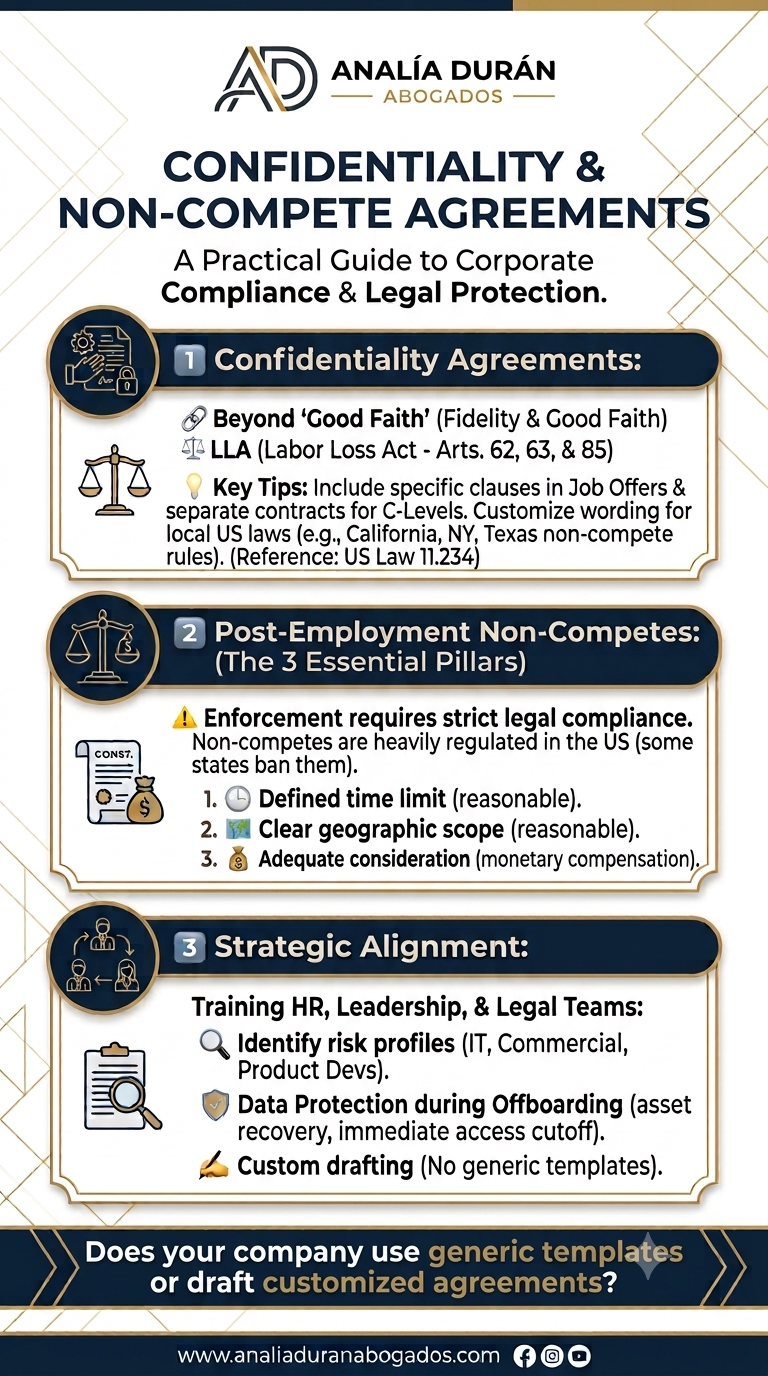
1. Confidentiality Agreements
Although Section 62, 63, and 85 of the Employment Contract Act (Ley de Contrato de Trabajo) include good faith, the general obligations of the parties, and the duty of loyalty which include confidentiality), it is recommended to include a specific confidentiality clause in employment contracts or job offer letters. Likewise, for high-level personnel, it is advisable to draft an
independent, detailed document if access to information is highly sensitive or could compromise know-how, trade, or industrial secrets.
- HR and Legal: It is quite common to use generic contracts, clauses, or handbooks. It is recommended to consult on the appropriate text based on the position's responsibility, specific function, and type of access to sensitive company data.
- Avoid standard templates: It is important not to automatically replicate employee handbooks used abroad that apply principles and laws unenforceable in Argentina. Always request that the wording be adapted to local law.
- Foreign Law: If foreign law is included, it is crucial to clearly understand its applicability, the costs of litigating abroad, or the possibility of judgment recognition.
- Local Regulations: Keep in mind Information Confidentiality Law No. 24,766.
2. Non-Compete Agreements (Post-Employment)
This is where the biggest mistakes are made. In Argentina, the right to work is protected by the National Constitution (Art. 14). Therefore, prohibiting someone from working in their field of expertise after leaving the company requires strict criteria to be valid:
- A time limit, geographic restriction, and financial compensation must be respected.
- Seeking legal counsel on the drafting of these agreements is recommended, as generic
terms that fail to provide full legal protection to the company can lead to litigation.
3. The Critical Importance of Training Human Resources, Senior Management, and Legal Teams
The disconnect between the team that hires/fires (HR) and the team that drafts contracts (Legal) is the primary cause of labor contingencies.
Why Train Human Resources and Key Management Positions?
- Identification of Risk Profiles: HR must know which positions (e.g., IT directors, commercial managers, product developers) justify activating these clauses and which do not. In the case of post-employment non-compete agreements, it is important to evaluate which employee hierarchy justifies the cost of implementation.
- Legal Alignment: Consult with Legal regarding potential conflicts and to review eventual contingencies.
- Data Protection Culture: Hiring and termination are critical moments for HR; therefore, all signed agreements must be reviewed, and documentation must be immediately recovered or restricted to protect the company's data and metadata.
- Tailored Drafting: Avoid "copy-pasting." A trained lawyer will draft the clause based on the
actual duties described by HR, minimizing the risk of future lawsuits.